Reliable L5M6 Test Dumps - L5M6 Current Exam Content
Wiki Article
BONUS!!! Download part of VCEEngine L5M6 dumps for free: https://drive.google.com/open?id=1zrcDiI4lsHLTTA7G8pzTw7fTt4ZrFsD-
When we update the L5M6 preparation questions, we will take into account changes in society, and we will also draw user feedback. If you have any thoughts and opinions in using our L5M6 study materials, you can tell us. We hope to grow with you and the continuous improvement of L5M6 training engine is to give you the best quality experience. And you can get the according L5M6 certification as well.
CIPS L5M6 Exam Syllabus Topics:
| Topic | Details |
|---|---|
| Topic 1 |
|
| Topic 2 |
|
| Topic 3 |
|
>> Reliable L5M6 Test Dumps <<
L5M6 Current Exam Content - Latest L5M6 Exam Question
Another great way to assess readiness is the L5M6 web-based practice test. This is one of the trusted online CIPS L5M6 prep materials to strengthen your concepts. All specs of the desktop software are present in the web-based CIPS L5M6 Practice Exam. MS Edge, Opera, Firefox, Chrome, and Safari support this L5M6 online practice test.
CIPS Category Management Sample Questions (Q74-Q79):
NEW QUESTION # 74
Jonah is a Procurement Specialist responsible for a sub-category of work which includes procuring skilled labour for construction. Sub-categories can also be known as what within a Category?
- A. Divisions
- B. Lots
- C. Commodities
- D. Sets
Answer: C
Explanation:
Within Category Management, sub-categories are often referred to as commodities. These are narrower groupings within a category that focus on specific goods or services. For example, within the Construction category, commodities might include raw materials, subcontracted labour, or specialist equipment hire.
Recognising commodities helps procurement apply tailored strategies that address their specific market dynamics and risk profiles. It also provides clarity when developing category plans, as different commodities may require different sourcing and supplier management approaches. By managing at both category and commodity levels, organisations can strike a balance between broad strategic alignment and detailed tactical execution.
Reference: CIPS L5M6 Study Guide, p.52
NEW QUESTION # 75
Trydo Ltd is an industrial engineering company and is currently assessing its supplier base. Below are descriptions of four of its major suppliers:
* Supplier 1: This supplier has a large share of the market and the market in which it operates is growing. However, the supplier's own costs have increased by 36% over the past 12 months due to raw material price increases.
* Supplier 2: The market is fast growing but as a new supplier to the marketplace, Supplier 2's market share is still relatively low. Trydo is concerned about this supplier's long-term financial situation as the company has taken out many loans and a large mortgage.
* Supplier 3: This supplier operates in a small marketplace, but is a strong player with a sizable market share. Although this isn't of concern to Trydo, having recently run an Acid Test, it is believed that Supplier 3's current liabilities are four times greater than its assets.
* Supplier 4: The market Supplier 4 operates in is shrinking and Supplier 4 already has a low market share. The main issue is Capital Management as stock turnover, debtor days and are becoming prolonged. There have been several complaints about performance.
Task:
Complete the table below. You are required, for each supplier, to determine the product category on the BCG Matrix and to identify the main area of financial concern. Each response should only be used once.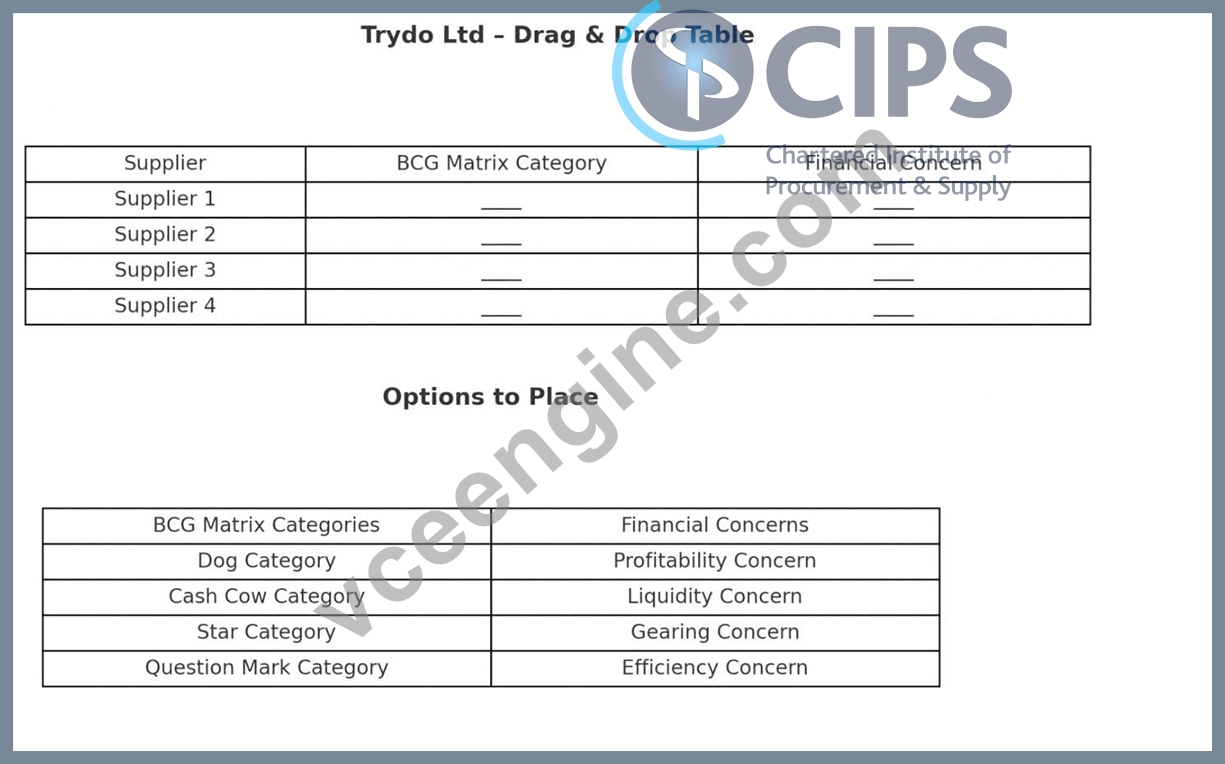
Answer:
Explanation: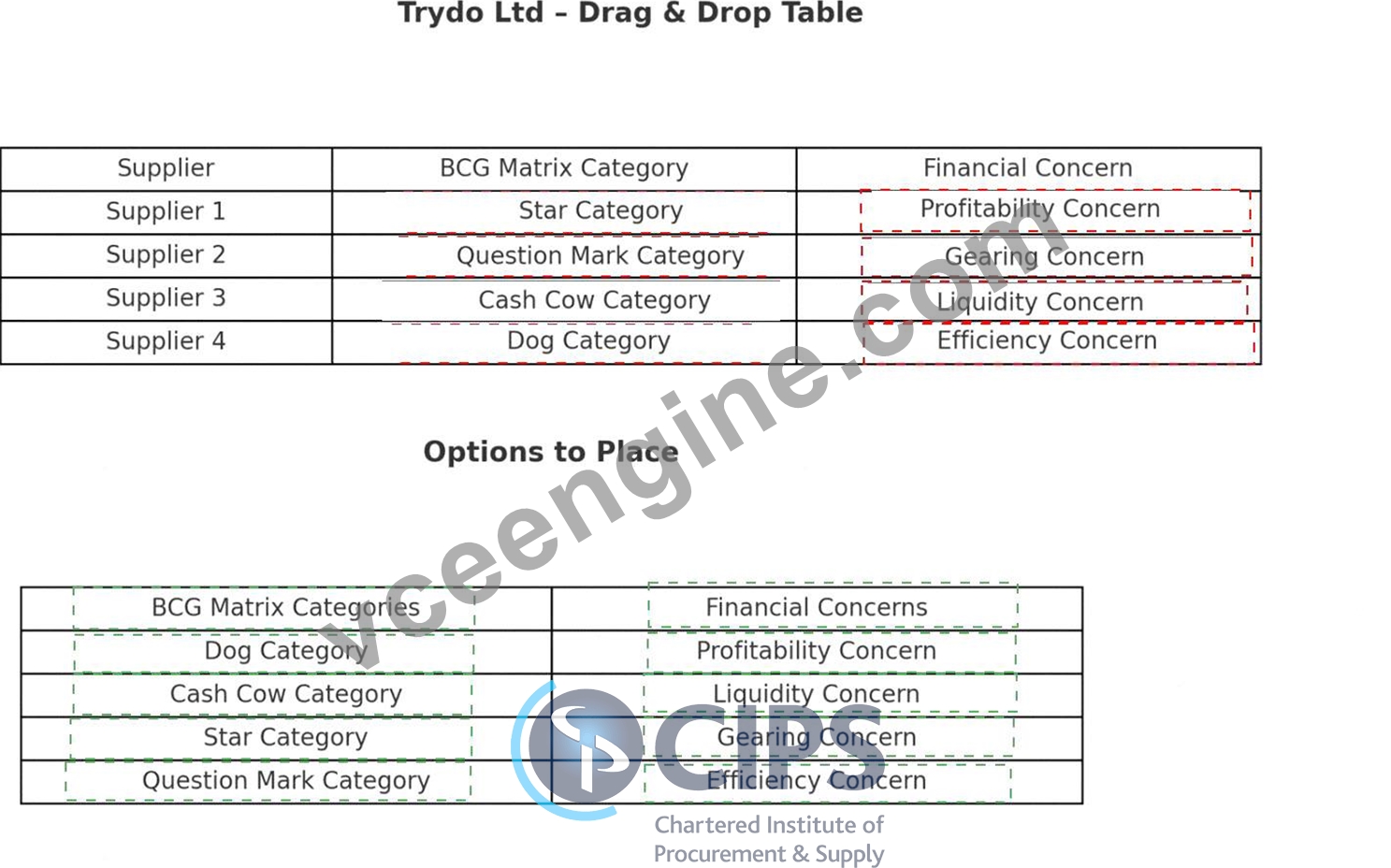
Explanation:
Output image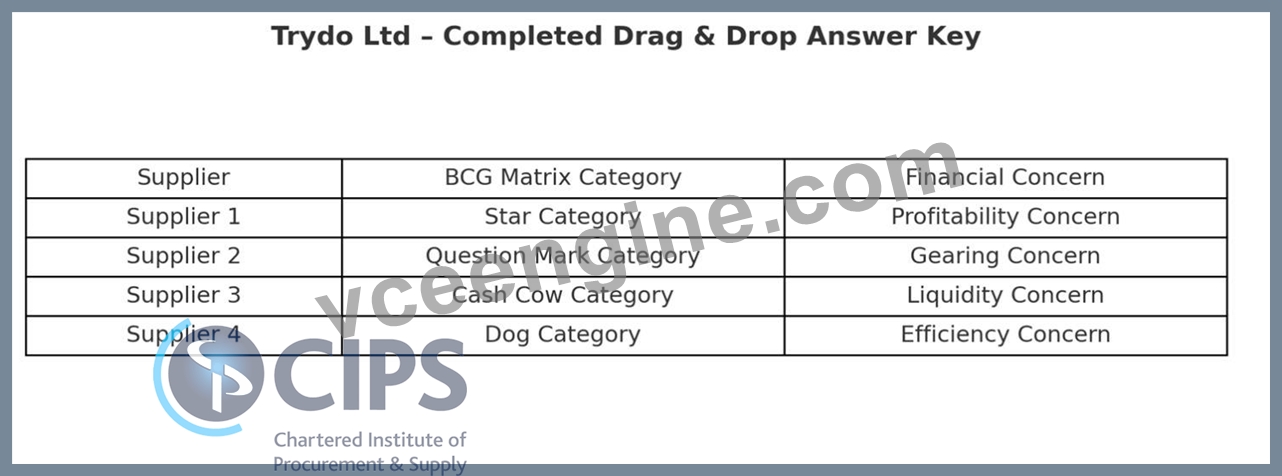
Supplier 1 # Star Category + Profitability Concern
Supplier 1 holds a large market share in a growing market, which places it in the Star category of the BCG Matrix. Stars are typically leaders in expanding markets and require continuous investment to maintain their dominance. The concern here is not competitive weakness but profitability. Although revenue potential is strong, Supplier 1's costs have increased by 36% due to rising raw material prices. This erodes margins and threatens profitability despite growth. Stars often generate high cash inflows, but if costs spiral out of control, their ability to sustain investment weakens. Profitability management (e.g., through cost reduction, supplier negotiations, or efficiency gains) is critical to ensuring Supplier 1 continues its growth trajectory and avoids slipping into the "Cash Cow" or "Dog" quadrants in the future.
(Ref: CIPS L5M6 Study Guide, p.117 - BCG Matrix application)
Supplier 2 # Question Mark Category + Gearing Concern
Supplier 2 operates in a fast-growing market but has only a small share, making it a Question Mark in the BCG Matrix. Question Marks are high-risk: they may grow into Stars or fail and become Dogs, depending on how they perform and whether investment supports expansion. The major financial concern here is gearing- Supplier 2 has taken out significant loans and a large mortgage, meaning it is heavily leveraged. High gearing increases financial risk, as debt repayments must be met regardless of market conditions. In rapidly growing markets, high gearing can restrict reinvestment and leave firms vulnerable to interest rate fluctuations or downturns. For Trydo, this means Supplier 2 could face difficulties sustaining its growth, posing supply chain risk. Monitoring debt levels and financial stability is essential before committing to long-term contracts.
(Ref: CIPS L5M6 Study Guide, pp.117-118 - Question Marks and financial analysis) Supplier 3 # Cash Cow Category + Liquidity Concern Supplier 3 operates in a small, stable market but commands a strong market share. This places it firmly as a Cash Cow-a business that generates consistent revenue without requiring major investment. Cash Cows fund other areas of a portfolio but face limited growth prospects. The concern here is liquidity. An Acid Test reveals that Supplier 3's current liabilities are four times greater than its assets, suggesting it lacks sufficient short-term liquidity to meet obligations. This imbalance can result in cash flow problems, even if long-term profitability remains sound. For Trydo, the risk is that Supplier 3 may fail to pay debts or manage day-to-day operations, creating supply disruption. Procurement managers must ensure financial health checks are conducted regularly and consider diversification strategies if reliance on Supplier 3 is high.
(Ref: CIPS L5M6 Study Guide, p.117 - Cash Cows and liquidity issues)
Supplier 4 # Dog Category + Efficiency Concern
Supplier 4 operates in a shrinking market and already holds a low market share, placing it in the Dog category of the BCG Matrix. Dogs are generally unattractive, offering little growth and limited returns. The key concern here is efficiency. Supplier 4 is struggling with capital management issues, such as poor stock turnover and prolonged debtor days. These inefficiencies damage competitiveness and further weaken financial stability. For Trydo, relying on Supplier 4 poses significant risk because inefficiency can lead to delays, reduced quality, and increased total cost of ownership. Unless Supplier 4 improves performance, it may eventually exit the market, leaving Trydo vulnerable. In procurement terms, buyers should avoid long- term commitments with such suppliers and instead focus on exit strategies or alternatives.
(Ref: CIPS L5M6 Study Guide, pp.117-118 - Dogs and efficiency management)
NEW QUESTION # 76
Joe is a Category Manager at an automobile company. Which of the following would be the best way to decide on categories in this industry?
- A. By spend
- B. By part
- C. Alphabetically
- D. By supplier
Answer: B
Explanation:
In the automobile industry, the most logical method for structuring categories is by part. Large manufacturing organisations, such as Ford or Toyota, procure thousands of parts and materials from hundreds of suppliers. To manage this complexity effectively, they segment procurement responsibilities into categories such as engines, tyres, glass, electronics, or body frames. This allows Category Managers to develop deep expertise in their assigned areas, improving supplier relationships and value delivery.
Other approaches are less effective:
* Alphabetical categorisation is impractical and arbitrary, providing no strategic value.
* By spend creates imbalances, as high-value categories would attract disproportionate workload and risk, leaving others underrepresented.
* By supplier could lead to inefficiency and over-fragmentation, as suppliers often provide multiple types of products.
The study guide stresses that categorisation must allow procurement teams to be efficient, balanced, and capable of strategic focus. By organising categories by part, managers can align more closely with engineering and production needs, ensuring better cross-functional collaboration.
[Ref: CIPS L5M6 Study Guide, p.3 - Defining categories in Category Management]
NEW QUESTION # 77
In A.T. Kearney's 7 Step Model of Strategic Sourcing, which of the following should be done first?
- A. Competitive supplier selection
- B. Selection of implementation path
- C. Continuous benchmarking of supply market
- D. Supplier portfolio generation
Answer: D
Explanation:
The first step in A.T. Kearney's 7 Step Model of Strategic Sourcing is Supplier Portfolio Generation. The model provides a structured approach to sourcing, beginning with an understanding of current spend and supplier landscape before progressing to strategy development and implementation.
The seven steps are:
* Profile spend and supply base.
* Develop sourcing strategy and cost comparison.
* Generate supplier portfolio.
* Select implementation path.
* Select competitive suppliers.
* Integrate operations with suppliers.
* Continuously benchmark supply market.
The reason supplier portfolio generation is first is because procurement must identify potential suppliers and the overall supply base structure before choosing strategies or engaging in competitive selection. Skipping this step risks building a strategy without understanding available market options.
Thus, while options C and D are important later in the process, they cannot occur without first mapping the supplier portfolio.
[Ref: CIPS L5M6 Study Guide, Chapter 1.2 - Strategic Sourcing Models, esp. p.31-32]
NEW QUESTION # 78
Which of the following are potential consequences for an organisation which fails to identify and address risk? Select TWO.
- A. Financial loss
- B. Lawsuits
- C. Corruption
- D. Damage to brand image
Answer: A,D
Explanation:
CIPS highlights that damage to brand reputation and financial loss are two major risks of failing to manage supply chain risks effectively. Legal issues such as lawsuits arise from illegal activity, which is separate from general risk exposure.
Reference: CIPS L5M6 Study Guide, p.111
NEW QUESTION # 79
......
In today's world, the Category Management (L5M6) certification exam has become increasingly popular, providing professionals with the opportunity to upskill and stay competitive in the tech industry. At VCEEngine, we understand the importance of obtaining the CIPS L5M6 Certification in the CIPS sector, where technological advancements constantly evolving.
L5M6 Current Exam Content: https://www.vceengine.com/L5M6-vce-test-engine.html
- Free PDF Valid CIPS - Reliable L5M6 Test Dumps ???? Easily obtain free download of ( L5M6 ) by searching on ➡ www.prepawayete.com ️⬅️ ♿L5M6 Exam Paper Pdf
- Pass Guaranteed 2026 CIPS Authoritative L5M6: Reliable Category Management Test Dumps ???? Search on ▶ www.pdfvce.com ◀ for ▛ L5M6 ▟ to obtain exam materials for free download ????L5M6 Real Dumps Free
- L5M6 Exam Cram Questions ???? Lab L5M6 Questions ???? New L5M6 Study Materials ???? ⇛ www.prepawayete.com ⇚ is best website to obtain ➤ L5M6 ⮘ for free download ➖New L5M6 Study Materials
- Pass Guaranteed 2026 CIPS Authoritative L5M6: Reliable Category Management Test Dumps ???? Search for ▷ L5M6 ◁ and download exam materials for free through ➽ www.pdfvce.com ???? ????New L5M6 copyright
- L5M6 Real Dumps Free ???? L5M6 copyright Torrent ???? L5M6 Books PDF ???? Download ▛ L5M6 ▟ for free by simply entering ➥ www.examcollectionpass.com ???? website ❣L5M6 Pdf Pass Leader
- 100% Pass 2026 The Best CIPS L5M6: Reliable Category Management Test Dumps ???? The page for free download of { L5M6 } on “ www.pdfvce.com ” will open immediately ????L5M6 Exam Paper Pdf
- Reliable L5M6 Test Experience ???? Certification L5M6 Exam ???? L5M6 Exam Paper Pdf ???? ➠ www.troytecdumps.com ???? is best website to obtain ▶ L5M6 ◀ for free download ????Lab L5M6 Questions
- L5M6 Pdf Pass Leader ???? L5M6 Exam Paper Pdf ???? Free L5M6 Study Material ⬆ Easily obtain free download of ➥ L5M6 ???? by searching on ➤ www.pdfvce.com ⮘ ????L5M6 Exam Cram Questions
- L5M6 Test Sample Questions ???? 100% L5M6 Exam Coverage ???? L5M6 Books PDF ???? Search for ▛ L5M6 ▟ and download it for free immediately on ⮆ www.torrentvce.com ⮄ ????L5M6 copyright Torrent
- Desktop-Based CIPS L5M6 Practice Test ???? Search for ✔ L5M6 ️✔️ and download it for free on ▛ www.pdfvce.com ▟ website ❇Excellect L5M6 Pass Rate
- CIPS L5M6 Exam? No Problem. Crack it Instantly with This Simple Method ???? Download ➠ L5M6 ???? for free by simply entering { www.exam4labs.com } website ????New L5M6 Study Materials
- teganejky553492.aboutyoublog.com, keiranmssy881349.wikidank.com, lombok-directory.com, bookmarksden.com, heathhcau703596.wannawiki.com, www.stes.tyc.edu.tw, haseebfhnx116871.angelinsblog.com, myportal.utt.edu.tt, myportal.utt.edu.tt, myportal.utt.edu.tt, myportal.utt.edu.tt, myportal.utt.edu.tt, myportal.utt.edu.tt, myportal.utt.edu.tt, myportal.utt.edu.tt, myportal.utt.edu.tt, myportal.utt.edu.tt, janauyjt820951.wikitelevisions.com, prestonqjxa631977.wikienlightenment.com, Disposable vapes
BONUS!!! Download part of VCEEngine L5M6 dumps for free: https://drive.google.com/open?id=1zrcDiI4lsHLTTA7G8pzTw7fTt4ZrFsD-
Report this wiki page